A shared pose interface
The proposed ten-link Cartesian representation connects reference motion and camera-derived targets to the backward map, without per-frame whole-body inverse kinematics upstream.
A learned latent sequencer for a frozen humanoid policy.
01 · The problem and idea
Behavioral foundation models can track diverse motions through a single latent-conditioned policy. In online teleoperation, however, incoming targets may be delayed, noisy, or intermittent. Executing each newly encoded goal directly passes these temporal imperfections into the command stream.
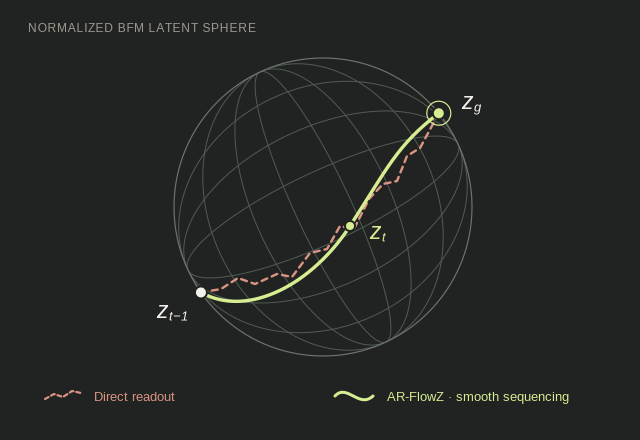
AR-FlowZ predicts the next executed latent from the current robot state, previous latent, latest goal, and recurrent history. A SLERP-centered source distribution provides a geometric prior on the normalized latent sphere. The multi-step Riemannian flow is distilled into a one-step teacher-endpoint predictor for 50 Hz execution, while the underlying BFM remains frozen.
02 · Interactive demo
Live MuJoCo WASM + ONNX Mini M1v3 policy (same stack as X-BFM). Pick a skill embedding from the real reward_z pack; the actor runs in the browser at 50 Hz with PD control. First load streams WASM + the actor (~130 MB).
Tips
z, and the latent sphere beside it follows.03 · How it works
A frozen FB-CPR backbone provides the latent space and policy. AR-FlowZ learns smooth latent transitions around a spherical base path and is distilled to one-step inference for 50 Hz control.
The proposed ten-link Cartesian representation connects reference motion and camera-derived targets to the backward map, without per-frame whole-body inverse kinematics upstream.
The transition model learns around a SLERP-centered prior on the normalized BFM latent sphere. Conditioning includes the state, previous latent, goal, and recurrent history.
An endpoint predictor is distilled from the multi-step flow for the intended 50 Hz control loop. The backward representation and latent-conditioned policy are unchanged.
04 · Results
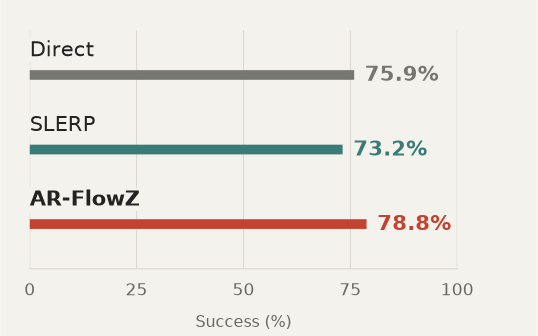
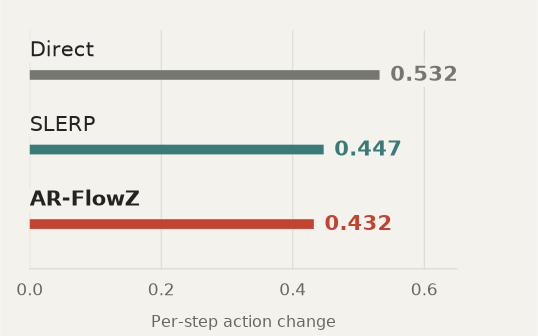
The central simulation claim is reward-conditioned behavior switching. Under degraded pose targets, SLERP accounts for most mean-action-rate smoothing; AR-FlowZ’s additional tracking gains are small and condition-dependent.
Simulation rollouts on Digit, not hardware. Each pair shares the task, seed, and scripted schedule; only the sequencing strategy differs.
75.9% Direct → 78.8% AR-FlowZ
Metrics. Transition success: target-behavior reward exceeds 0.3 within three seconds after a switch. Action rate: per-step action change ‖at − at−1‖ (mean, p99, or peak as labeled). Protocol: 46-second schedule, 64 environments × three seeds. Smoother transitions do not imply fewer falls: fall rate is 8.3% for AR-FlowZ and 6.6% for Direct.
| Method | Reward ↑ | Succ. (%) ↑ | R@2s ↑ | Action rate ↓ | p99 ↓ | Peak ↓ | Falls (%) ↓ |
|---|---|---|---|---|---|---|---|
| Direct | .319 | 75.9 | .201 | .147 | .494 | .532 | 6.6 |
| SLERP | .302 | 73.2 | .174 | .140 | .463 | .447 | 7.8 |
| AR-FlowZ (ours) | .335 | 78.8 | .219 | .134 | .416 | .432 | 8.3 |
Tradeoff: AR-FlowZ improves success, early reward, and action-rate peaks relative to Direct, while reporting a higher fall rate (8.3% vs 6.6%). Pose-tracking accuracy, ablations, and camera memory are under Detailed evaluation.
05 · Real-robot evaluation
Hardware demonstrations on Digit, together with per-joint command-tracking measurements from a representative camera-driven run. Mean commanded-versus-measured joint error |qdes − q| is 3.4° (arms) and 11.9° (legs); this is not human-to-robot pose error. These measurements characterize execution with AR-FlowZ; they do not establish an improvement over Direct or SLERP on hardware.
Additional hardware clips
06 · Detailed evaluation
Supporting comparisons: Joint-versus-Pose interface accuracy, component ablations, and camera front-end memory. Mean/p99 action rates and per-transition values are shown in the charts above each retained table.
SLERP accounts for most of the improvement in mean action rate under degraded pose targets. AR-FlowZ provides small, condition-dependent improvements in p99 action rate, while SLERP performs better under 10% latent noise. Paired p99 differences are distinguishable from zero in only three of eight shared conditions (mean ± two-standard-error).


| Condition | Key-link error (m) ↓ | Joint-angle error (rad) ↓ | ||
|---|---|---|---|---|
| Joint | Pose | Joint | Pose | |
| Full rate | .0870 | .0800 | .2215 | .2137 |
| Camera-like | .1177 | .1074 | .2825 | .2707 |
| 1-in-3 frames | .0900 | .0824 | .2275 | .2183 |
| 1-in-5 frames | .0928 | .0849 | .2332 | .2231 |
| 1-in-10 frames | .0993 | .0905 | .2462 | .2349 |
| 100 ms delay | .1009 | .0918 | .2503 | .2381 |
| 5% pose noise | .0871 | .0800 | .2217 | .2141 |
| 10% latent noise | .1070 | .0982 | .3250 | .2745 |
| Unseen random | .0951 | .0684 | .3262 | .2232 |


All seven reported transitions appear in the charts above (no separate table). Absolute jump reward remains below 0.02 for both methods. Jump success indicates a brief threshold crossing, not sustained jumping.
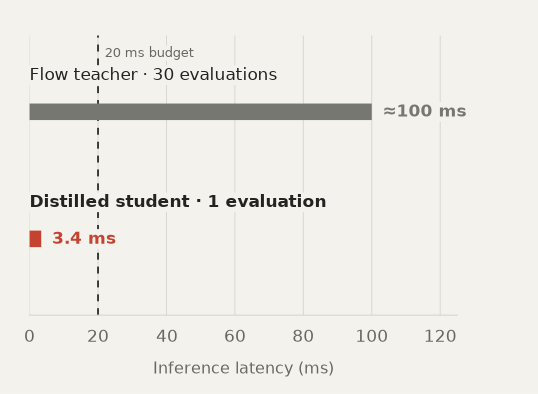
Component ablations at 1-in-5 target frames. Ablation runtimes for teacher variants are teacher-based estimates. Tracking here is global position error (includes root drift), which differs from the key-link error in the pose-tracking table.
| Variant | Action rate ↓ | Track. (m) ↓ | Time (ms) ↓ | Label (rad) ↓ |
|---|---|---|---|---|
| Direct | .1713 | .804 | n/a | n/a |
| SLERP only (δ = 0.2208) | .1650 | .816 | 0.008 | n/a |
| Teacher (NFE = 30) | .1651 | .817 | ≈100 | .0728 |
| w/o recurrent memory | .1654 | .821 | ≈100 | .0753 |
| w/o SLERP path | .1945 | .863 | ≈100 | .4068 |
| Distilled (ours), NFE = 1 | .1651 | .817 | 3.4 | n/a |
Latency is camera front-end processing only; it excludes robot latency and does not measure end-to-end teleoperation delay.
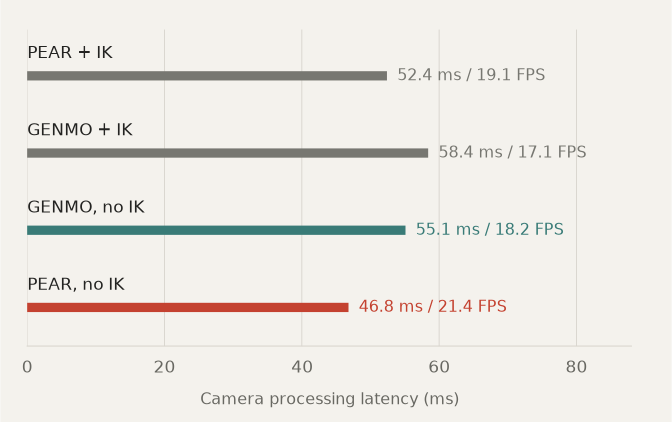
| Config | GPU (GB) ↓ | RAM (GB) ↓ |
|---|---|---|
| PEAR + IK | 3.60 | 2.99 |
| GENMO + IK | 16.72 | 5.02 |
| GENMO, no IK | 16.72 | 4.78 |
| PEAR, no IK (ours) | 3.60 | 3.00 |
07 · Limitations
AR-FlowZ relies on reference-derived transition supervision, which provides limited guidance when the robot state deviates substantially from the reference. State-adaptive falling or recovery under large state–target mismatch is therefore not established.
AR-FlowZ sequences behaviors represented by the frozen policy; it does not establish new physical skills beyond that repertoire.
Hardware evaluation includes suit- and camera-driven demonstrations, together with per-joint command-tracking measurements (|qdes − q|) from a representative camera-driven run (mean arm 3.4°, leg 11.9°). These characterize execution with AR-FlowZ; they do not establish an improvement over Direct or SLERP on hardware. No hardware success-rate or end-to-end latency claims are made beyond the camera front-end throughput in Table 5.
08 · Citation
Publication metadata pending.