HUMANOID CONTROL / LATENT SKILL SEQUENCINGRESEARCH PROJECT

AR-FlowZ. : Autoregressive Riemannian Latent Flows for Latent Skill Sequencing in Behavioral Foundation Models

A learned latent sequencer for a frozen humanoid policy.

Author names and affiliations forthcoming

Lead demo video

Real robot · Camera teleoperation

Video forthcomingCamera-driven recovery
Camera-driven recovery. Monocular camera teleoperation of a frozen BFM with AR-FlowZ on Digit.
On this page
  1. 01Idea
  2. 02Interactive demo
  3. 03Method
  4. 04Results
  5. 05Real Robot
  6. 06Detailed evaluation
  7. 07Limitations
  8. 08Citation

Direct latent replacement is brittle. Learned sequencing is the intervention.

Behavioral foundation models can track diverse motions through a single latent-conditioned policy. In online teleoperation, however, incoming targets may be delayed, noisy, or intermittent. Executing each newly encoded goal directly passes these temporal imperfections into the command stream.

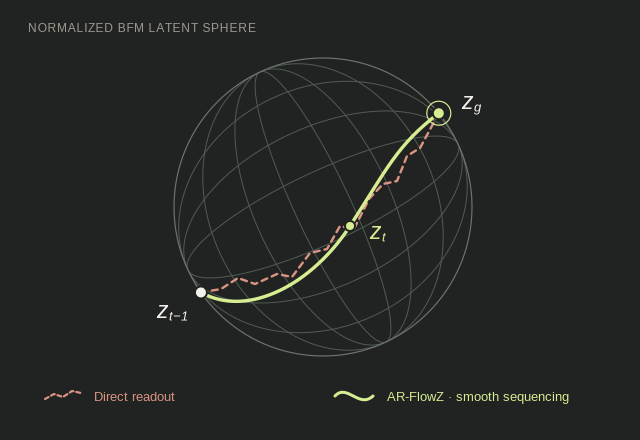
AR-FlowZ predicts the next executed latent from the current robot state, previous latent, latest goal, and recurrent history. A SLERP-centered source distribution provides a geometric prior on the normalized latent sphere. The multi-step Riemannian flow is distilled into a one-step teacher-endpoint predictor for 50 Hz execution, while the underlying BFM remains frozen.
Try the interactive demo ↓

Conceptual schematic on a dark globe: muted coral dashed direct-readout path versus pale chartreuse AR-FlowZ smooth sequencing from z_t-1 toward goal z_g. Not measured data.
THE LATENT SPACEConceptual schematic

Interactive Demo

Live MuJoCo WASM + ONNX Mini M1v3 policy (same stack as X-BFM). Pick a skill embedding from the real reward_z pack; the actor runs in the browser at 50 Hz with PD control. First load streams WASM + the actor (~130 MB).

Tips

  1. Tap a skill button (or W/A/S/D, Q/E, C, R) — the live policy switches z, and the latent sphere beside it follows.
  2. Drag the robot to perturb; P push · Space pause · Backspace reset.
  3. Open fullscreen for a larger viewport.

Open live demo (fullscreen)

Latent sphere · live skill z

Waiting for live demo…

Synced to the live sim. Marker moves with each skill switch.

A frozen backbone. Geometric transitions. One-step deployment.

A frozen FB-CPR backbone provides the latent space and policy. AR-FlowZ learns smooth latent transitions around a spherical base path and is distilled to one-step inference for 50 Hz control.

Fig. 01 · Framework

Figure forthcomingResearch media
Method overview. BFM pretraining, followed by frozen-backbone latent-sequencer training and deployment. Riemannian flow training uses one-step teacher-endpoint distillation; closed-loop inference maps retargeted goals to the next latent for the frozen policy.
02A

A shared pose interface

The proposed ten-link Cartesian representation connects reference motion and camera-derived targets to the backward map, without per-frame whole-body inverse kinematics upstream.

02B

A geometric starting point

The transition model learns around a SLERP-centered prior on the normalized BFM latent sphere. Conditioning includes the state, previous latent, goal, and recurrent history.

02C

One-step deployment

An endpoint predictor is distilled from the multi-step flow for the intended 50 Hz control loop. The backward representation and latent-conditioned policy are unchanged.

Cleaner switches between reward-specified behaviors.

The central simulation claim is reward-conditioned behavior switching. Under degraded pose targets, SLERP accounts for most mean-action-rate smoothing; AR-FlowZ’s additional tracking gains are small and condition-dependent.

Fig. 02 · Direct readout vs AR-FlowZ

Video forthcomingResearch media
Behavior switching. The same task and seed: Direct pose-latent readout on the left, AR-FlowZ on the right. Hard-switched reward latents over a 46 s schedule, including the bend→squat→lie descent and getup. Overlays show command, reward, latent distance |z − zgoal|, and rate (mean and p99).

Fig. 03a · Dance sequence I

Video forthcomingResearch media
Dance sequence I. Ghost overlay, same task and seed: Direct pose-latent readout (translucent) versus AR-FlowZ (solid).

Fig. 03b · Dance sequence II

Video forthcomingResearch media
Dance sequence II. Ghost overlay, same task and seed: Direct pose-latent readout (translucent) versus AR-FlowZ (solid).

Fig. 03c · Fight sequence

Video forthcomingResearch media
Fight sequence. Ghost overlay, same task and seed: Direct pose-latent readout (translucent) versus AR-FlowZ (solid).

Fig. 03d · Walking sequence

Video forthcomingResearch media
Walking sequence. Ghost overlay, same task and seed: Direct pose-latent readout (translucent) versus AR-FlowZ (solid).

Simulation rollouts on Digit, not hardware. Each pair shares the task, seed, and scripted schedule; only the sequencing strategy differs.

78.8% Transition success

75.9% Direct → 78.8% AR-FlowZ

−18.8% Peak action rate vs Direct
−15.9% p99 action rate vs Direct

Metrics. Transition success: target-behavior reward exceeds 0.3 within three seconds after a switch. Action rate: per-step action change ‖at − at−1‖ (mean, p99, or peak as labeled). Protocol: 46-second schedule, 64 environments × three seeds. Smoother transitions do not imply fewer falls: fall rate is 8.3% for AR-FlowZ and 6.6% for Direct.
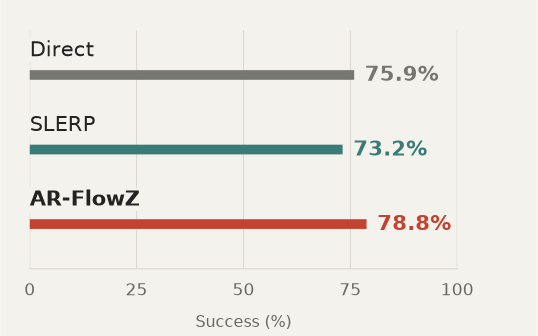
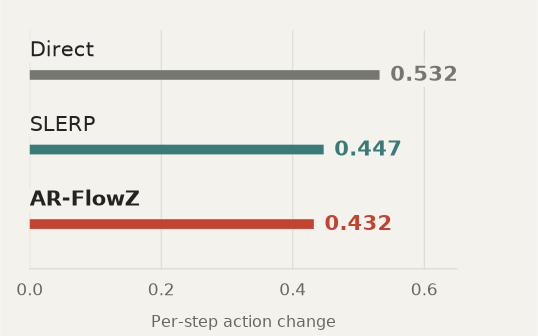
Transition success ↑

Direct 75.9%; SLERP 73.2%; AR-FlowZ 78.8%. Higher is better.

Peak action rate ↓

Direct 0.532; SLERP 0.447; AR-FlowZ 0.432. Lower is better.

Table 1 · Behavior switching

Behavior switching with reward-derived goals, aggregate over the full 46 s schedule (64 environments × three seeds). Charts above show success and peak action rate; this table additionally preserves Reward, R@2s, mean/p99 action rate, and falls. Success: target-behavior reward exceeds 0.3 within three seconds. R@2s: mean target-behavior reward over the first two seconds after switching. Action rate: per-step action change ‖at − at−1‖. Bold marks best. Falls = pelvis < 0.4 m during the 3-s switch window, excluding switches into/out of lie or squat.
Method Reward ↑ Succ. (%) ↑ R@2s ↑ Action rate ↓ p99 ↓ Peak ↓ Falls (%) ↓
Direct.31975.9.201.147.494.5326.6
SLERP.30273.2.174.140.463.4477.8
AR-FlowZ (ours).33578.8.219.134.416.4328.3

Tradeoff: AR-FlowZ improves success, early reward, and action-rate peaks relative to Direct, while reporting a higher fall rate (8.3% vs 6.6%). Pose-tracking accuracy, ablations, and camera memory are under Detailed evaluation.

Suit- and camera-driven execution on Digit.

Hardware demonstrations on Digit, together with per-joint command-tracking measurements from a representative camera-driven run. Mean commanded-versus-measured joint error |qdes − q| is 3.4° (arms) and 11.9° (legs); this is not human-to-robot pose error. These measurements characterize execution with AR-FlowZ; they do not establish an improvement over Direct or SLERP on hardware.

Fig. 04 · Camera-driven recovery

Video forthcomingHardware demonstration
Camera-driven recovery. Monocular camera teleoperation of a frozen BFM with AR-FlowZ on Digit. State-adaptive recovery under large state–target mismatch is not established.

Fig. 05 · Overview collage

Overview figure forthcomingCamera, mocap suit, and reward-specified sequencing
Camera and mocap-suit teleoperation of a frozen BFM with AR-FlowZ, plus reward-specified behavior sequencing on Digit.

Fig. 06 · Suit-driven walking

Video forthcomingHardware demonstration
Suit-driven walking. Balance-sensitive locomotion tracked from a low-latency motion-capture suit.

Fig. 07 · High knee → lie down

Video forthcomingHardware demonstration
High knee → lie down. A high-knee motion followed by a controlled transition to lying down, across a large behavior change.

Fig. 08 · Walk → lie down

Video forthcomingHardware demonstration
Walk → lie down. Walking into a smooth standing-to-lying transition under a continuous suit stream.

Fig. 09 · Pick and place

Video forthcomingHardware demonstration
Pick and place. Arm-led manipulation tracked from the suit while the frozen policy keeps balance.

Additional hardware clips

Fig. 10 · Camera-driven walking

Video forthcomingHardware demonstration
Camera-driven walking. Monocular camera teleoperation transitioning into locomotion tracked by the frozen policy.

Fig. 11 · Camera-driven stand-up

Video forthcomingHardware demonstration
Camera-driven stand-up. Monocular camera teleoperation driving a transition from a low pose to standing.

Fig. 12 · Arm teleoperation into stepped walking

Video forthcomingHardware demonstration
Arm teleoperation into stepped walking. Camera-driven arm tracking followed by a step-by-step walking sequence under the same teleoperation stream.

Fig. 13 · Lift left leg

Video forthcomingHardware demonstration
Lift left leg. Suit-driven single-leg lift, tracked from the motion-capture suit while the frozen policy maintains balance.

Fig. 14 · Lift and hold left leg, twice

Video forthcomingHardware demonstration
Lift and hold left leg, twice. Suit-driven repeated single-leg lift-and-hold, testing sustained single-support balance.

Fig. 15 · Suit-driven lie down

Video forthcomingHardware demonstration
Suit-driven lie down. Standing-to-lying transition under a continuous motion-capture stream.

Fig. 16 · Walk, backward walk, and turn

Video forthcomingHardware demonstration
Walk, backward walk, and turn. Suit-driven forward walking, backward walking, and turning in a single continuous sequence.

Fig. 17 · Multi-human teleoperation handoff

Video forthcomingHardware demonstration
Multi-human teleoperation handoff. Monocular camera teleoperation tracked continuously as the human operator moves and control transitions from one person to another, with the frozen policy keeping the robot's motion unbroken across the handoff.

Pose tracking, ablations, and camera front-end.

Supporting comparisons: Joint-versus-Pose interface accuracy, component ablations, and camera front-end memory. Mean/p99 action rates and per-transition values are shown in the charts above each retained table.

Pose tracking under degraded targets

SLERP accounts for most of the improvement in mean action rate under degraded pose targets. AR-FlowZ provides small, condition-dependent improvements in p99 action rate, while SLERP performs better under 10% latent noise. Paired p99 differences are distinguishable from zero in only three of eight shared conditions (mean ± two-standard-error).

Mean action rate ↓

All nine conditions. Gray circles: Direct (Pose); teal squares: SLERP; vermilion diamonds: AR-FlowZ. Exact values are printed at right. The horizontal axis is zoomed; differences are small.

p99 action rate ↓

Same conditions and methods. Point estimates only; no uncertainty intervals were supplied in the page. SLERP is lower under 10% latent noise.
Same conditions and methods. Points show reported aggregate values; uncertainty intervals are not shown. SLERP is lower under 10% latent noise.

Interface accuracy · Joint versus Pose

Interface accuracy under direct readout, without AR-FlowZ (Joint versus Pose backbones). Mean and p99 action-rate columns are omitted here; they appear in the charts above. Key-link error removes root drift. Shared-corpus rows use 256 clips; unseen motions are evaluated at full rate.
ConditionKey-link error (m) ↓Joint-angle error (rad) ↓
JointPoseJointPose
Full rate.0870.0800.2215.2137
Camera-like.1177.1074.2825.2707
1-in-3 frames.0900.0824.2275.2183
1-in-5 frames.0928.0849.2332.2231
1-in-10 frames.0993.0905.2462.2349
100 ms delay.1009.0918.2503.2381
5% pose noise.0871.0800.2217.2141
10% latent noise.1070.0982.3250.2745
Unseen random.0951.0684.3262.2232

Notable switches

Success by transition ↑

Gray circles: Direct; vermilion diamonds: AR-FlowZ. All seven reported transitions are shown, including lower success for transitions out of lying.

Time to target ↓

Time to first reward-threshold crossing, in seconds. Gray circles: Direct; vermilion diamonds: AR-FlowZ. Lower is better.

All seven reported transitions appear in the charts above (no separate table). Absolute jump reward remains below 0.02 for both methods. Jump success indicates a brief threshold crossing, not sustained jumping.

Component ablations

Component ablations at 1-in-5 target frames. Ablation runtimes for teacher variants are teacher-based estimates. Tracking here is global position error (includes root drift), which differs from the key-link error in the pose-tracking table.
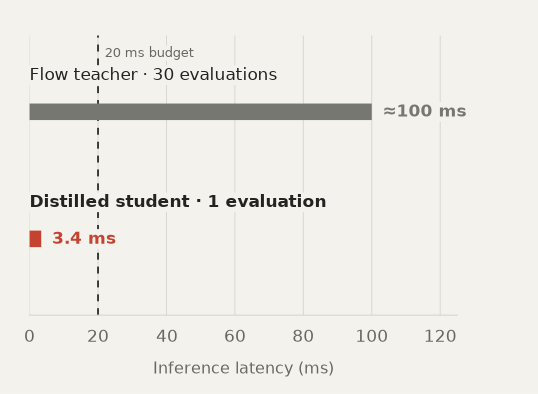
One-step inference fits the control budget

Teacher: approximately 100 ms. Distilled student: 3.4 ms. Dashed line: 20 ms per 50 Hz control cycle. Approximately 29× faster inference; teacher latency is approximate.

Table 4 · Component ablations

Component ablations at 1-in-5 target frames. Tracking is global position error (m); time is inference latency per command (ms); Label is angular error to the reference next latent (rad). Ablation runtimes use teacher inference.
Variant Action rate ↓ Track. (m) ↓ Time (ms) ↓ Label (rad) ↓
Direct.1713.804n/an/a
SLERP only (δ = 0.2208).1650.8160.008n/a
Teacher (NFE = 30).1651.817≈100.0728
w/o recurrent memory.1654.821≈100.0753
w/o SLERP path.1945.863≈100.4068
Distilled (ours), NFE = 1.1651.8173.4n/a

Camera front-end throughput

Latency is camera front-end processing only; it excludes robot latency and does not measure end-to-end teleoperation delay.
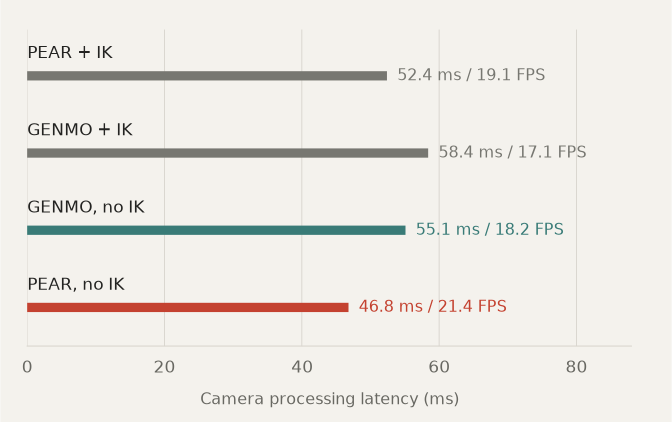
Camera front-end latency ↓

Four configurations on RTX A5000. Labels include latency and FPS. Camera processing only; excludes robot latency and end-to-end teleoperation delay.

Camera front-end · Memory usage

Camera front-end memory on RTX A5000. Latency and FPS appear in the chart above. The “no IK” rows emit link poses directly; the “+ IK” rows additionally solve whole-body IK. Bold marks best.
Config GPU (GB) ↓ RAM (GB) ↓
PEAR + IK3.602.99
GENMO + IK16.725.02
GENMO, no IK16.724.78
PEAR, no IK (ours)3.603.00

Scope of the claims.

01

Reference-derived transition supervision

AR-FlowZ relies on reference-derived transition supervision, which provides limited guidance when the robot state deviates substantially from the reference. State-adaptive falling or recovery under large state–target mismatch is therefore not established.

02

Sequencing remains bounded by the backbone

AR-FlowZ sequences behaviors represented by the frozen policy; it does not establish new physical skills beyond that repertoire.

03

Hardware metrics

Hardware evaluation includes suit- and camera-driven demonstrations, together with per-joint command-tracking measurements (|qdes − q|) from a representative camera-driven run (mean arm 3.4°, leg 11.9°). These characterize execution with AR-FlowZ; they do not establish an improvement over Direct or SLERP on hardware. No hardware success-rate or end-to-end latency claims are made beyond the camera front-end throughput in Table 5.

Paper and BibTeX.

Publication metadata pending.